


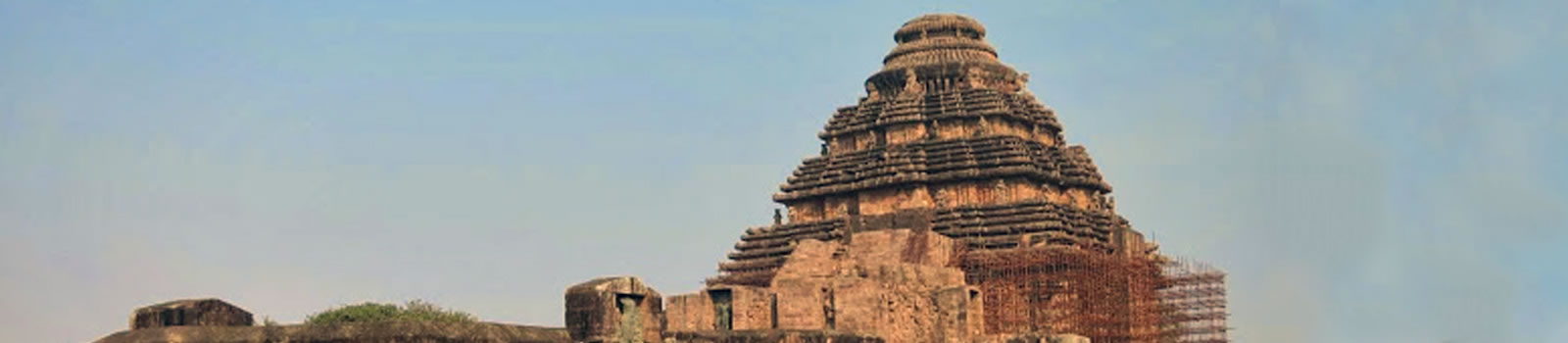
Rising dramatically amidst casuarina dunes along the Bay of Bengal just 35 km from Puri, the 13th-century Konark Sun Temple is a globally celebrated UNESCO World Heritage site and the supreme architectural achievement of medieval India.
Built by Emperor Narasimhadeva I of the Eastern Ganga Dynasty circa 1250 CE, this monumental temple was conceived as a colossal cosmic chariot of Surya (the Sun God) equipped with 24 carved stone sundial wheels drawn by seven spirited horses. As Nobel laureate Rabindranath Tagore famously wrote: "Here the language of stone surpasses the language of man."

European maritime navigators sailing along the Bay of Bengal in the 16th and 17th centuries relied on Odisha's monumental coastal shrines as primary navigational landmarks. They christened Konark the "Black Pagoda" in stark contrast to the whitewashed "White Pagoda" of Shree Jagannath Temple in Puri.
Originally erected directly at the ocean's shoreline (before the sea receded), the dark weathered khondalite spire of Konark soared 227 feet into the sky, casting a towering dark silhouette visible miles out at sea.
Maritime legends claimed that a massive lodestone (natural magnet) placed at the apex of the tower caused European ships to crash on sandbanks by pulling the iron nails from their hulls, leading Portuguese sailors to remove the stone.
King Narasimhadeva I marshaled the entire economic revenue of the Kalinga Empire for 12 continuous years and employed 1,200 master craftsmen under architect Bisu Maharana to bring this celestial vision to reality.
The entire temple structure was daringly designed as the celestial chariot of Surya, carrying the Sun God across the heavens:
The 24 Stone Wheels: Measuring 9 feet 9 inches in diameter, 12 pairs of wheels adorn the northern and southern flanks of the plinth. They symbolize the 24 fortnights (Pakshas) of the Hindu lunar calendar, and the 24 hours of day and night.
The 7 Spirited Horses: Seven dynamically sculpted war stallions strain at their stone harnesses, representing the seven days of the week, the seven sacred meters of Sanskrit verse (Chandas), and the seven colors of the solar spectrum (VIBGYOR).
Three Statues of the Sun God: Carved from rare greenish chlorite stone, three statues capture the Sun at dawn (Baladitya), midday zenith, and setting twilight (Astagata Surya), positioned so the sun's rays illuminate each deity at the precise solar hour.
The wheels of Konark are not mere decorative carvings — they are precision scientific astronomical instruments. Each wheel features 8 major spokes and 8 minor spokes:
The 8 Major Spokes: Divide the 24-hour day into 8 Praharas (each Prahara equals 3 hours). The major spoke pointing vertically upward represents midnight, while the opposite represents midday.
The 8 Minor Spokes: Sub-divide each Prahara into 90-minute intervals.
Calculating Exact Minutes: The outer rim is adorned with 30 carved beads between each spoke (each bead representing 3 minutes). By placing a finger or small stick at the center of the axle hub and observing where the shadow falls across the beads, one can calculate local solar time accurately down to the minute!
Every square inch of the temple plinth and walls vibrates with sublime sculptural relief celebrating life, devotion, and royal power:
The Hall of Dance stands on a soaring carved plinth directly before the Jagamohana. Intricate friezes depict celestial maidens (Alasa Kanyas) playing cymbals, mridanga drums, flutes, and performing classical Odissi dance mudras.
Colossal stone war elephants trampling adversaries and rearing battle stallions guard the stairways, symbolizing the imperial military might of King Narasimhadeva I who defeated invading Sultanate armies.
Sensuous erotic carvings (Mithuna) represent the vitality of creation and celebrate the sacred union of Purusha and Prakriti, serving as a reminder that pilgrims must transcend worldly desires before entering the inner sanctum.
After 12 years of agonizing labor, 1,200 master sculptors led by chief architect Bisu Maharana found themselves unable to fit the heavy crowning stone (Dadhinauti) upon the soaring 227-foot spire. Infuriated, King Narasimhadeva I issued a royal decree: if the kalasa was not set by the next morning's sunrise, all 1,200 craftsmen would be beheaded.
That evening, Bisu Maharana’s 12-year-old son, Dharmapada, who was born after his father left for Konark, arrived at the site. Having studied ancient architectural treatises, the prodigy solved the engineering riddle and fixed the crowning stone overnight. Realizing that the king would still execute the 1,200 craftsmen for their failure to do it themselves, the brave boy leaped from the temple spire into the churning waves of the Chandrabhaga sea, sacrificing his young life to save the lives of 1,200 sculptors.
The 35-kilometre scenic drive from Puri Holiday Resort to Konark along the Puri-Konark Marine Drive is one of the most picturesque coastal highways in India. Consider these memorable stops en-route:
Located just 3 km before the Sun Temple, this pristine Blue Flag certified beach is famous as the spot where Lord Krishna’s son Samba was cured of leprosy after worshipping Surya. Famed for breathtaking sunrises.
A tranquil seaside temple dedicated to Goddess Ramachandi, beautifully situated where the Kushabhadra river peacefully empties into the Bay of Bengal. A popular picnic spot with boating.
The Marine Drive cuts through this lush coastal forest reserve of casuarina and cashew plantations, home to herds of spotted deer, blackbucks, monkeys, and coastal migratory birds.
Puri Holiday Resort provides the ultimate base for exploring the Konark Sun Temple. Located on Chakratirtha Road, our dedicated travel desk arranges private air-conditioned cabs, knowledgeable local heritage guides, and flexible day itineraries.
Enjoy a healthy morning breakfast at our resort, embark on a scenic 45-minute drive along the Marine Drive, explore Konark during the soft morning light, and return in time to relax by our swimming pool and enjoy evening beachfront dining.
Essential facts and practical tips for visitors:

PLEASE PROVIDE GOVT. APPROVED PHOTO IDENTITY CARD OF ALL ADULT PERSON AT THE TIME OF CHECKING IN